Steak or Sizzle: Dirty Dangles, TikTok Clips, and the Difference Between Looking Skilled and Winning Hockey Games.
In today’s hockey world, the line between skill development and entertainment is getting blurrier by the day.
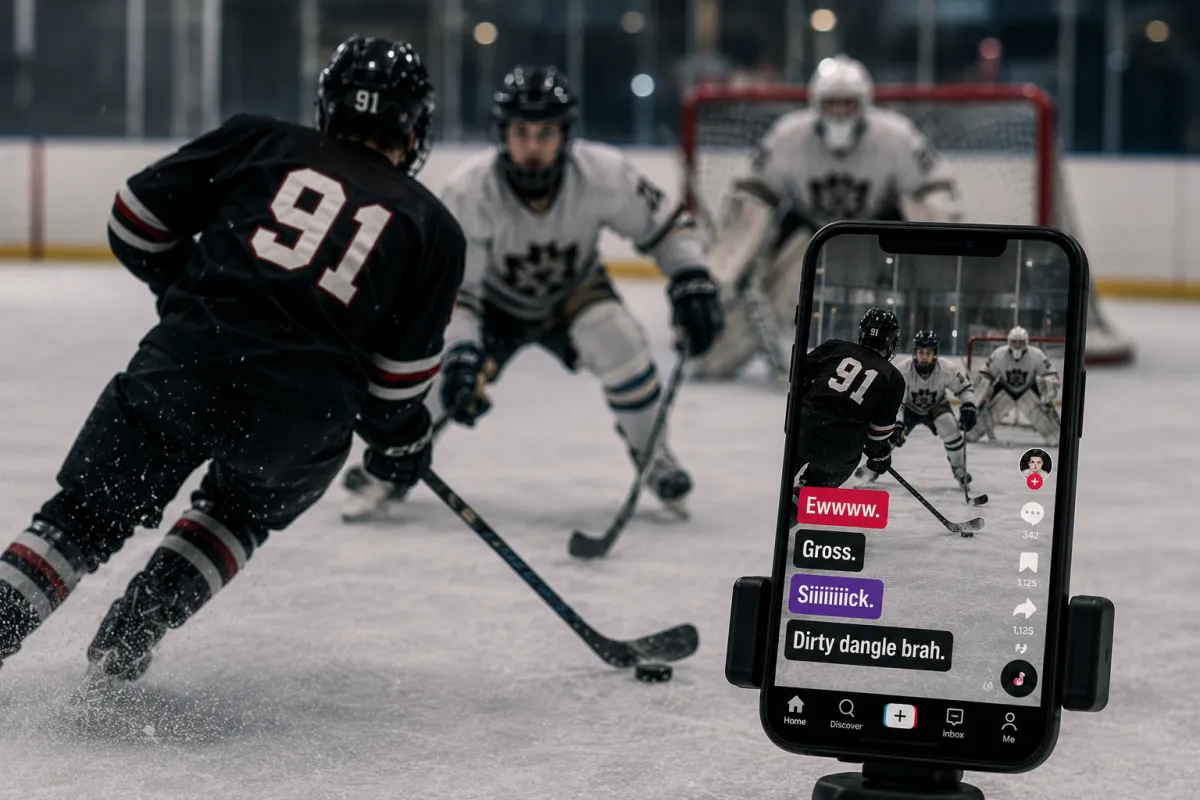
“Ewwww.”
“Gross.”
“Siiiiiiick.”
“Dirty dangle brah.”
An 8-to-15-second clip hits social media and suddenly every young player in North America is trying Michigan goals from below the goal line, saucing pucks over the garage, or stickhandling through a backyard obstacle course while their buddies launch tires, pylons, lawn chairs, and household debris at them like a real-life game of Frogger.
Some of it is incredibly creative.
Some of it is fun.
Some of it even helps skill development.
But somewhere along the way, hockey started confusing the sizzle for the steak.
Because while social media rewards the spectacular, the game itself still rewards substance.
The Era of the Clip
Kids today consume hockey differently.
They don’t just watch full games anymore.
They consume:
clips,
reels,
edits,
highlights,
and viral moments.
They’re learning hockey in 8-to-15-second bursts.
And the problem with clips is they often show the outcome without the context.
They see:
the Michigan,
the toe drag,
the breakaway move,
the viral dangle.
But they don’t always see:
the shoulder check,
the reload,
the puck support,
the wall play,
the timing,
the positioning,
or the detail that made the play possible in the first place.
Kids are learning hockey through clips, not context.
It’s changing how players view skill itself.
The Trampoline Floor Problem
And I get it.
If you ask almost any young player what they want to practice, it’s probably not:
chip-outs,
wall retrievals,
stick positioning,
reload routes,
or making safe five-foot plays under pressure.
It’s the splashy stuff.
The eye-catching stuff.
The:
“Ewwww.”
“Gross.”
“Siiiiiiick.”
And kids are supposed to think that stuff is cool.
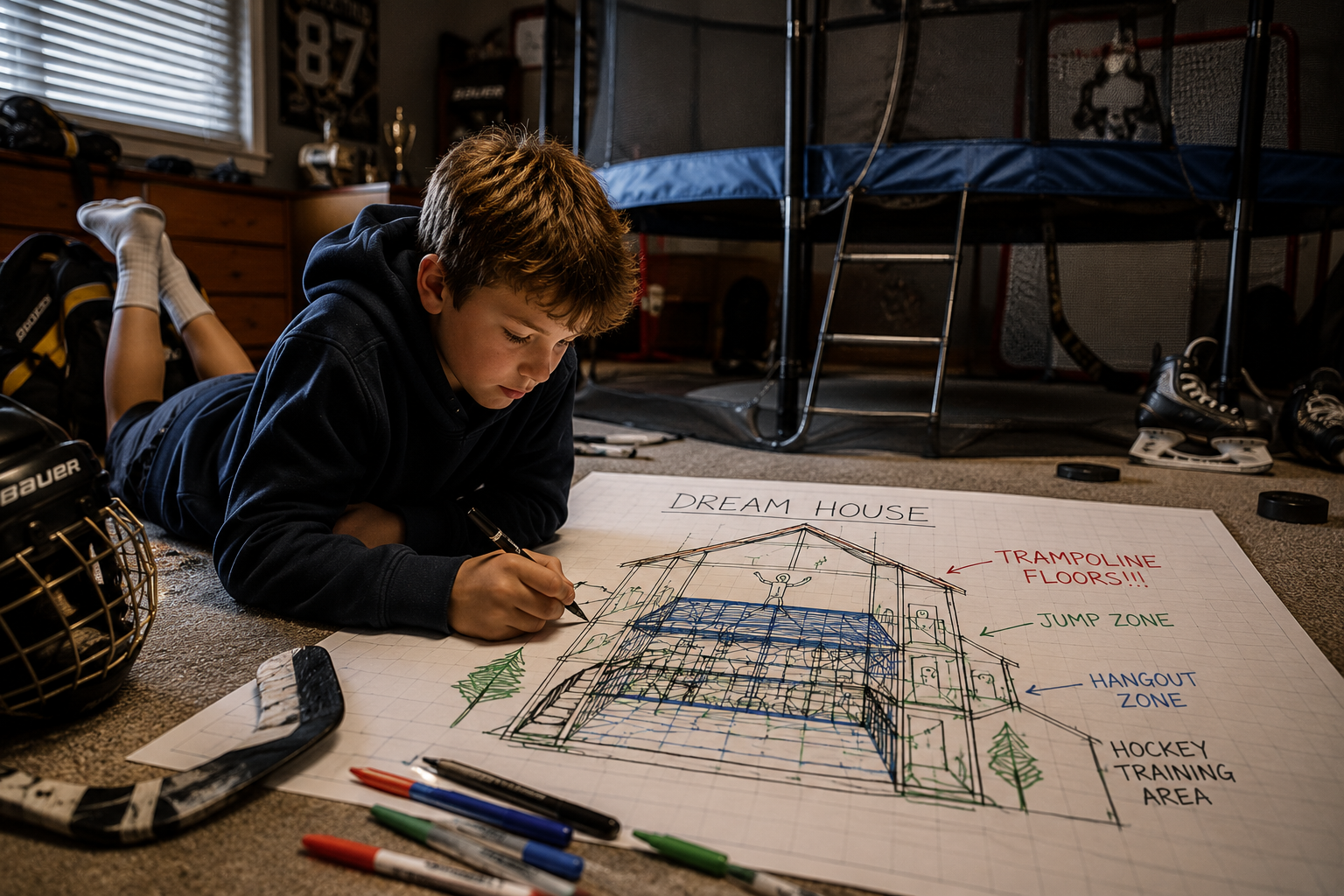
When I was in Norm Cleveland’s 8th-grade drafting class, I designed a house with trampoline floors because I thought that was the greatest idea in human history.
At 14 years old?
Awesome.
At my current age?
A trampoline floor feels like a torn ACL waiting to happen.
That’s kind of the whole point here.
As we mature, our understanding of:
risk,
reward,
functionality,
and purpose
usually matures too.
Same thing with hockey.
Skill development matters.
Creativity matters.
Confidence matters.
But eventually players start realizing there’s a difference between:
what gets reactions,
andwhat actually helps you win.
And in today’s world, that line gets blurrier by the day because we consume everything through handheld screens in 8-to-15-second bursts before swiping to:
a cat video,
a guy reviewing Costco chicken wings,
or somebody teaching their golden retriever how to skateboard.
That constant cycle rewards:
entertainment,
speed,
reaction,
and spectacle.
Which is probably why so many young players naturally gravitate toward the “wow” factor of hockey development.
That makes complete sense.
The important part is simply understanding that highlight hockey and winning hockey aren’t always the exact same thing.
Skill vs Hockey Skill
There’s a massive difference between isolated skill and transferable hockey skill.
Anybody can stickhandle around:
tires,
cones,
sticks,
lawn chairs,
or a cousin throwing pool noodles at them in the driveway.
But hockey isn’t played against stationary obstacles.
It’s played against intelligent athletes trying to take away your:
time,
space,
options,
and confidence.
I see a lot of players today who are absolute first-rounders in:
beer league,
summer hockey,
3v3 tournaments,
and Instagram clips.
Players who can stickhandle through a maze of tires, execute highlight-reel moves, and make people say:
“Ewwww.”
“Gross.”
“Dirty dangle.”
But then the season starts.
The game becomes structured 5-on-5 hockey against real thinking humans with equal or better talent, tighter details, and a more polished understanding of how to actually play the game.
And suddenly the space disappears.
The move that worked against a pile of stationary obstacles doesn’t work nearly as well against defenders who:
angle properly,
close time and space,
track body position,
and understand layers of defensive structure.
Because hockey isn’t a skills competition.
It’s problem-solving at high speed under pressure.
The Ferrari Problem

Skill acquisition, development, improvement, and retention are all incredibly important.
Players should learn:
creativity,
deception,
edge work,
puck control,
confidence,
and problem-solving.
That evolution is good for hockey.
But the real separator at higher levels isn’t simply:
“Can you do it?”
It becomes:
“Do you understand when to do it?”
And maybe even more importantly:
“What happens if it doesn’t work?”
That’s hockey maturity.
Because every move carries risk.
One decision might create offense.
The other might end up in the back of your net.
That’s the part social media doesn’t always teach.
A Ferrari is designed to drive 200 miles per hour.
That doesn’t mean you drive it 200 through a school zone.
The capability isn’t the issue.
The awareness is.
And as funny as it sounds, Peter Parker carried Uncle Ben’s advice with him every time he pulled on the unitard and mask to become the friendly neighborhood hero we all admired:
“With great power comes great responsibility.”
Because elite hockey players don’t just understand skill.
They understand:
game state,
risk,
consequence,
and the team's goals.
Anybody can make a flashy play.
The hardest thing in hockey is making the right play consistently.
The Private Lesson Dilemma
That’s the part I struggle with sometimes when doing private lessons.
Everybody wants to learn the fancy stuff.
Everybody wants:
toe drags,
Michigan goals,
lacrosse moves,
between-the-legs plays,
and the kind of skill that becomes a seven-second TikTok clip.
And I get it.
It’s fun.
It’s creative.
It’s part of where the modern game is headed.
But if I give a 14-year-old player the choice between:
toe drags,
learning how to properly chip pucks off the glass,
pick up rims on the wall,
puck retrievals,
make five-foot support plays under pressure…
…it’s toe drags for 60 straight minutes.
Followed by their buddy losing his mind beside the net going:
“Ewwww.”
“Gross.”
“Siiiiiiick.”
“Dirty dangle brah.”
Because the flashy stuff gets applause immediately.
The problem is, the game itself usually rewards something different.
Nobody posts a highlight reel of:
winning a wall battle,
making a smart reload,
getting pucks out clean,
supporting underneath pressure,
or making the safe play at the right time.
But those are the habits coaches trust.
And trust is what gets players moved up the lineup.
That’s the disconnect sometimes between:
highlight hockey,
and
winning hockey.
Because one rewards attention.
The other rewards winning.
Coaches Celebrate the Decision
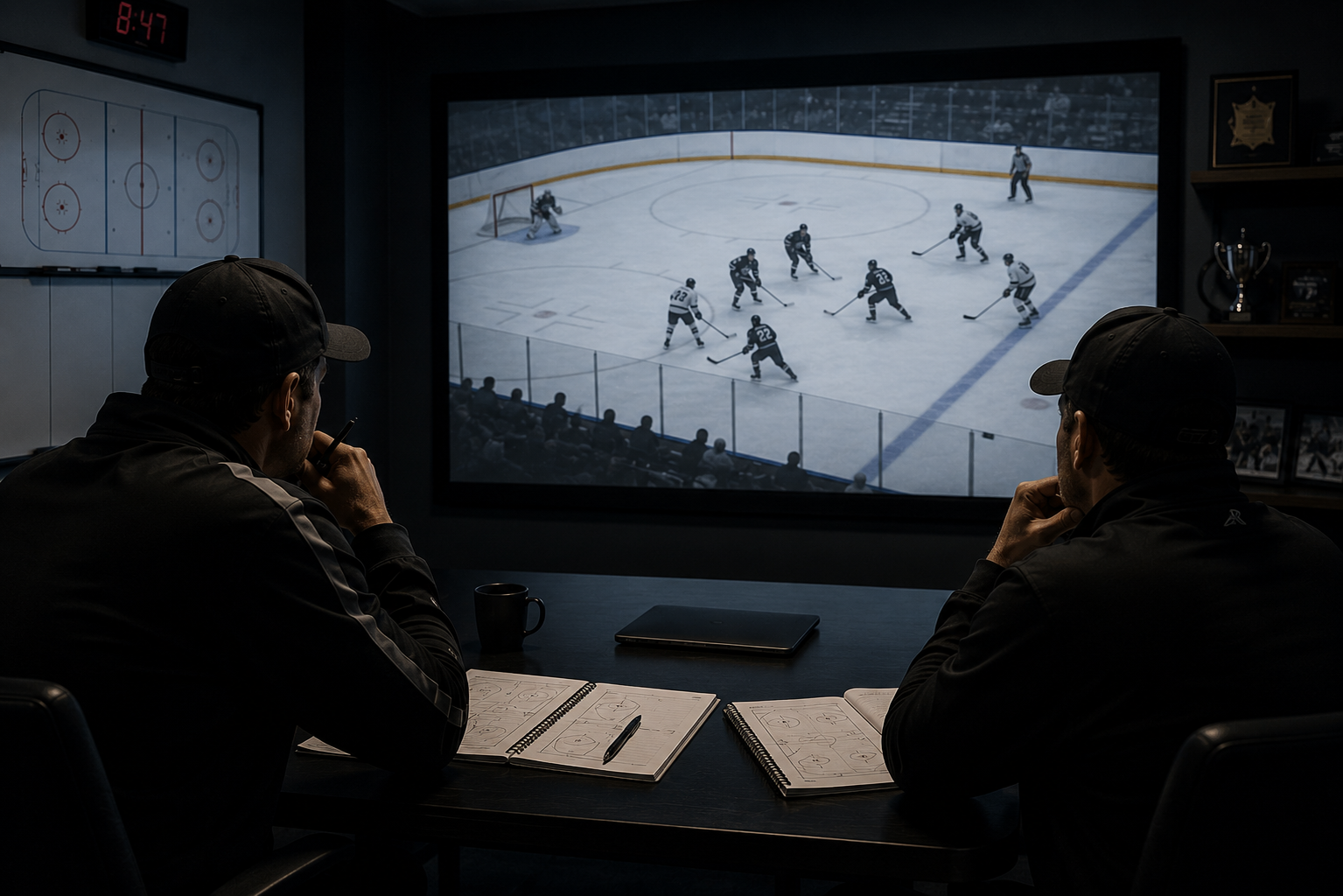
The funny thing is, if you sit in on a coaches’ video session after a game, the highlight tape usually looks a lot different than social media.
Coaches aren’t pausing clips saying:
“Look at this triple toe drag into a windmill Michigan!”
They’re usually highlighting substance plays.
“Look at this player take a hit to make a play.”
“Look at this player recognize pressure and put the puck into space instead of trying to beat someone 1-on-1 at the blue line.”
“Look at this angle and stick position to create a 50/50 puck.”
“Look at this player protect the puck on the wall and help us kill 20 seconds on a penalty kill.”
That’s trust.
That’s winning hockey.
Those details usually decide games far more often than the viral stuff does.
Players celebrate the move.
Coaches celebrate the decision.
Skill will always be part of hockey.
And the coaches teaching creativity, deception, edge work, and puck skill have helped elevate the modern game to incredible levels. Players today are far more advanced technically than they were 20 years ago.
That evolution is a good thing.
But skill without context can become empty calories.
Because the hardest part of hockey isn’t learning a move.
It’s understanding:
when to use it,
where to use it,
why to use it,
and what happens if it fails.
That’s hockey IQ.
That’s maturity.
That’s the difference between:
“Can make a play”
and
“Can play.”
Czech Lessons
I remember playing in the Czech Republic and seeing this disconnect firsthand.
A guy would attack 1-on-5, beat the first defender with some high-skill play, then lose the puck to the second defender and watch while the other team transitioned to offense and our bench would erupt like he’d just scored an overtime winner.
Guys yelling.
Sticks tapping.
Everybody going crazy because the first move itself looked incredible.
Meanwhile, I’d get the puck with five defenders stacked in front of me and hard-rim it into the offensive zone to start a forecheck because forcing a high-risk pass into traffic would’ve put us in trouble.
And I’d have all my teammates looking at me like:
“You go get it.”
No applause.
No “gross bro.”
No viral clip.
Just a simple hockey play that gave our team structure, pressure, and a chance to recover possession.
That’s one of the biggest differences between hockey that looks good and hockey that actually wins.
Because high-level hockey isn’t just about what’s possible.
It’s about understanding probability, support, risk, and consequence in real time.
Sometimes the smartest play on the ice is also the least exciting one to post online.
What Are You Training For?
None of this is meant to throw shade at the hockey entertainers either.
A lot of those guys are highly skilled former players who simply found a different lane.
And good for them.
Building brands, entertaining people, growing the game, creating content, and connecting with younger audiences takes talent too.
Hockey needs personalities.
Hockey needs creativity.
Hockey needs people who make the game fun.
The point isn’t:
“This is bad.”
The point is simply understanding what you’re training for.
Because entertainment and elite competition are not always the same thing.
Sometimes they overlap beautifully.
Sometimes they don’t.
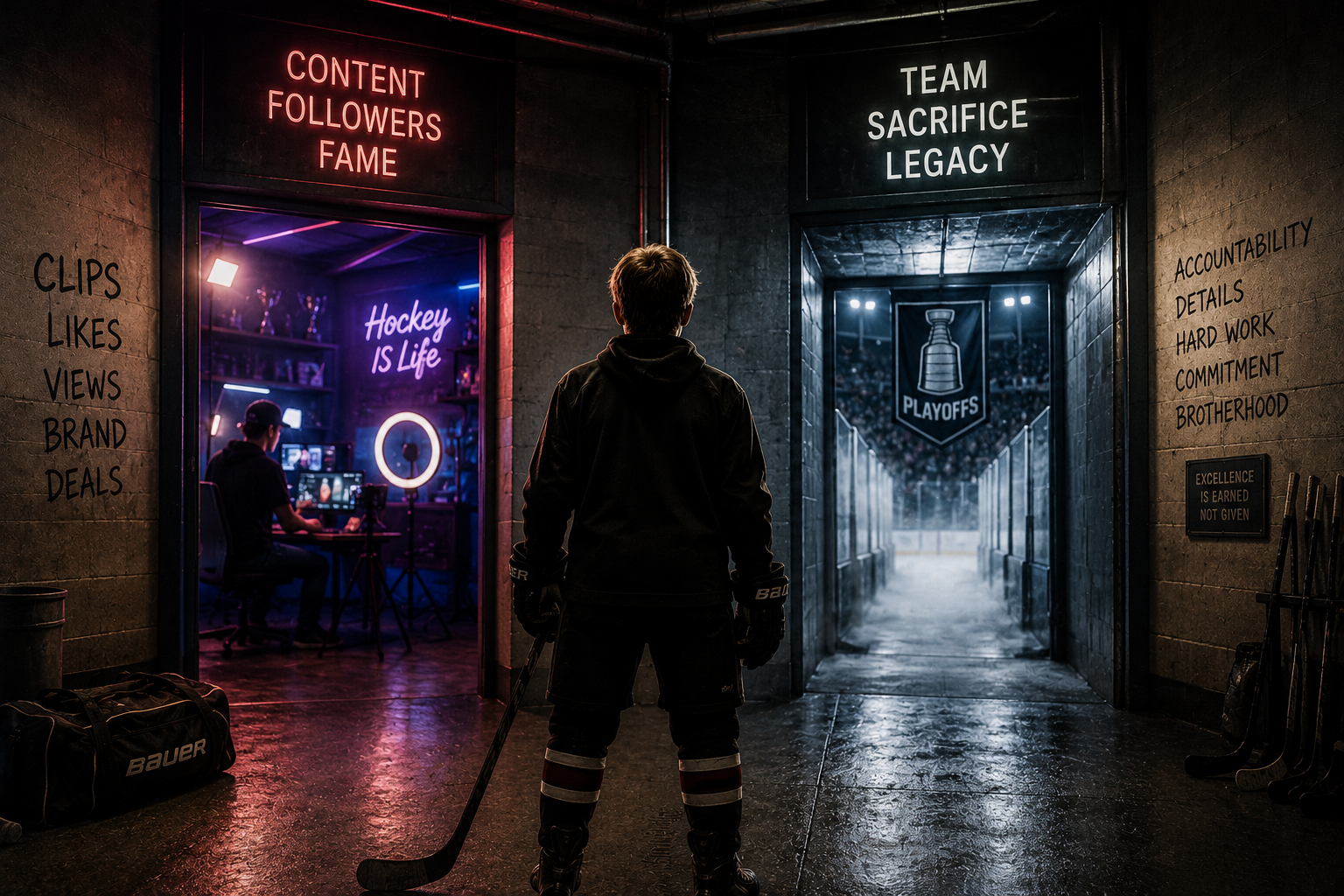
And eventually every player reaches a point where they have to answer a pretty honest question:
“What do I actually want?”
Do you want:
followers,
attention,
clips,
creativity,
entertainment,
and branding?
Or do you want:
trust,
difficult minutes,
playoff hockey,
championships,
and your name engraved somewhere in history?
Neither answer is wrong.
They’re just different roads.
Entertainment vs Competition
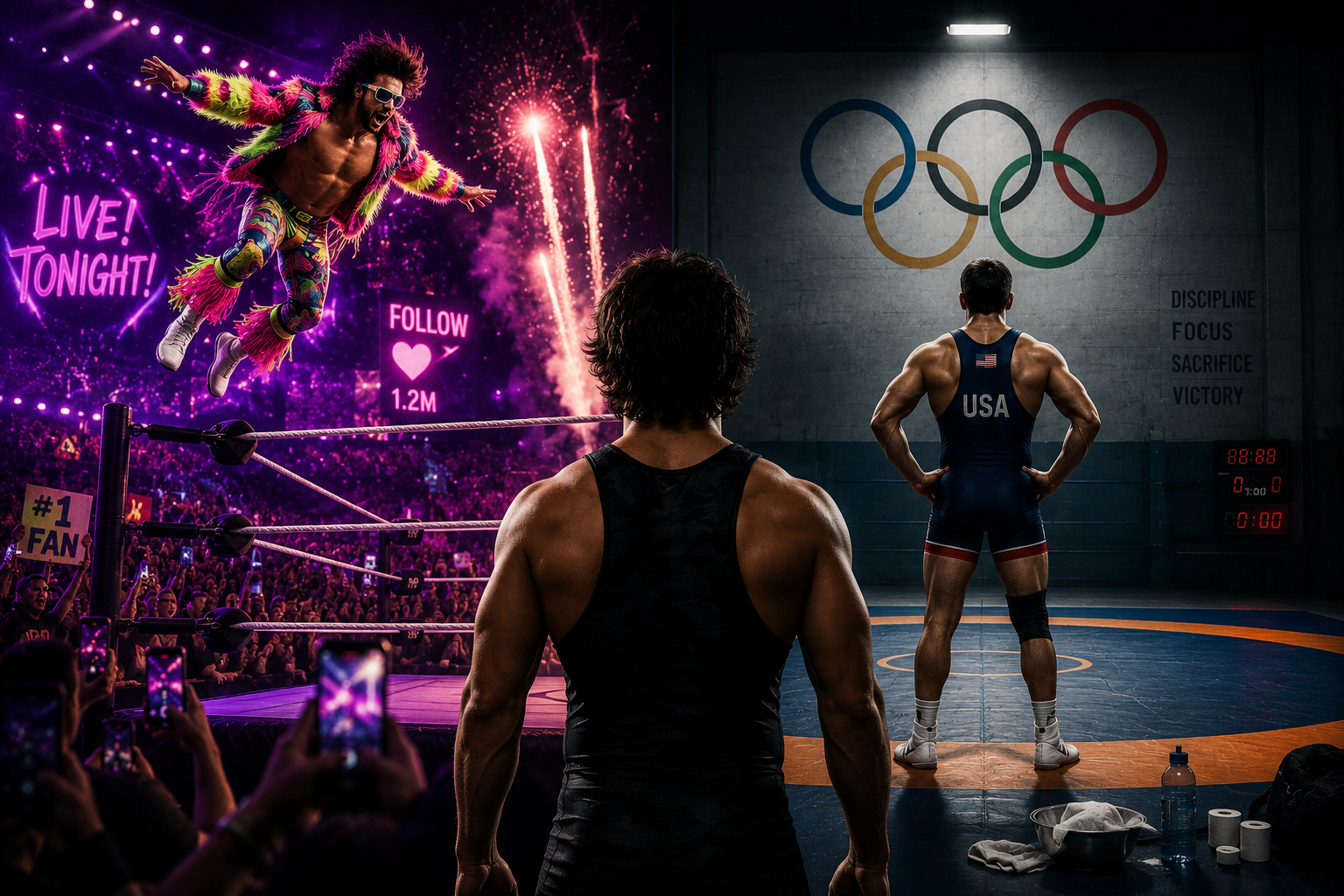
And to be clear, this isn’t me disrespecting entertainers either.
I love John Cena.
A record 17 world championships in WWE is incredible.
Same with Dwayne Johnson.
The Rock became a 10-time world champion and “the most electrifying man in sports entertainment” before turning that fame into a billion-dollar empire involving movies, production companies, tequila brands, energy drinks, and countless other ventures.
That level of success is rare.
But if we’re being honest, that’s still a different world than stepping onto an Olympic wrestling mat in the heavyweight division trying to win a gold medal against the best pure wrestlers on earth.
Different crafts.
Different objectives.
Different measurements of greatness.
I think hockey is starting to develop similar lanes.
There’s entertainment hockey.
And there’s competitive hockey.
Sometimes they overlap.
Sometimes they don’t.
And maybe that becomes the real question for young players.
What are you actually chasing?
Because growing up, my dream was never to become the richest man on earth.
It wasn’t followers.
It wasn’t branding.
It wasn’t internet fame.
My dream was to have Wayne Gretzky hand me the Stanley Cup in an Edmonton Oilers jersey so I could raise it toward the ceiling at Northlands Coliseum.
That was the dream.
And I still don’t know what I’d choose if someone offered:
all the money in the world
or
your name engraved on the Stanley Cup forever.
Because for hockey people, immortality has always meant something different. 🏒
About the Author
Darrell grew up a full-blown wrestling nut during the golden era of Hulkamania, following Hulk Hogan, The Ultimate Warrior, and Bret “The Hitman” Hart religiously every weekend. Dinner at the Hay house often ended with an epic match on the living room floor, with Dad embracing his role as the heel, “Rowdy” Roddy Piper, while Darrell played the all-American hero, Hulk Hogan. It was a nightly main event, and in Darrell’s version of history, Hulkamania always found a way to prevail.
To this day, he still says his prayers and takes his vitamins exactly like “The Hulkster” instructed all the Hulkamaniacs to do back in the day.
Turns out hockey and wrestling actually taught him the same lesson: there’s a difference between entertainment and championship-level execution.
