Coaching Hockey Is Not Nintendo: Lessons Learned From 8 Pixels
I grew up during the golden age of Nintendo.
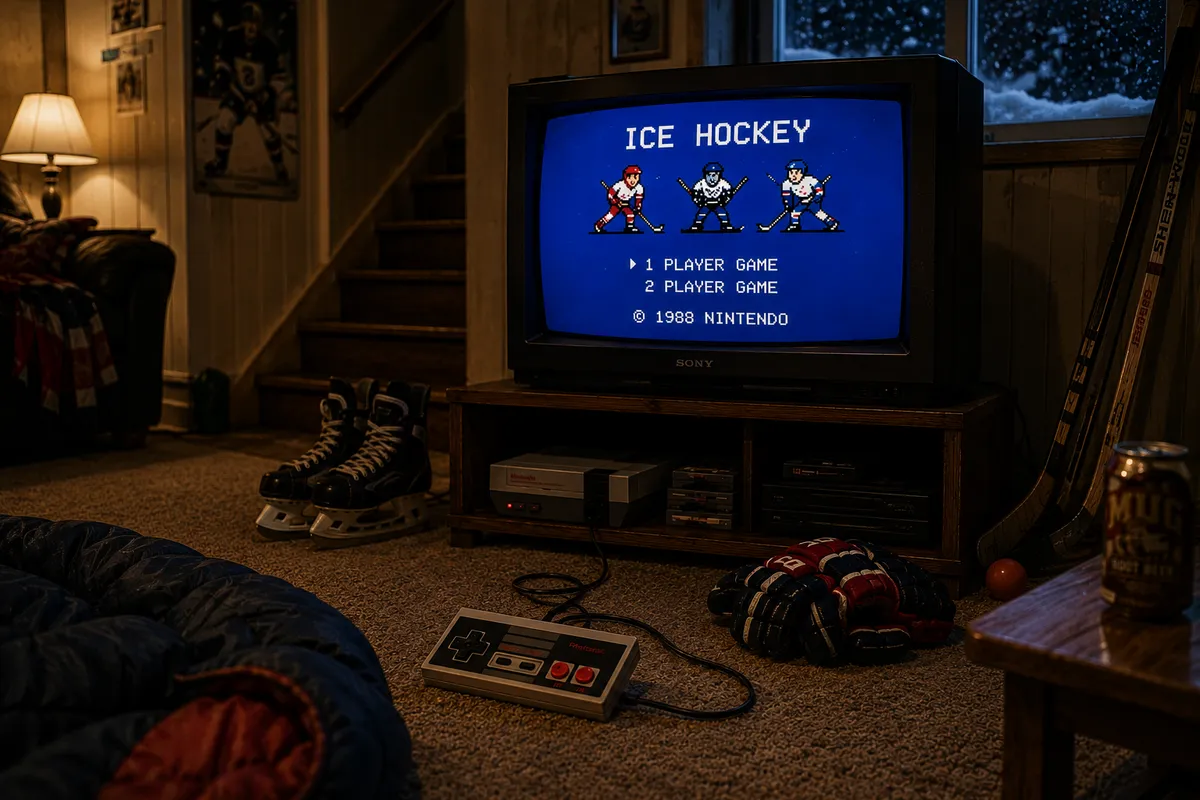
Our NES sat downstairs in the basement in Kamloops. It wasn't something we played every day because my parents believed kids belonged outside. If the weather was decent, we were riding bikes, playing street hockey, building forts, shooting hoops, or finding some way to burn off energy. Nintendo usually appeared when it was miserable outside, after a sleepover, or at the end of a long day of mini sticks and driveway hockey.
Like most kids in the early 90's, our game collection wasn't exactly endless. There was no downloading games. There was no online store. There was no subscription service giving us access to thousands of titles. We had what we had.
Mario Brothers and Duck Hunt. RBI Baseball. Contra. Punch-Out. Zelda.
And for me, the undisputed king was Ice Hockey.
One of the things I loved most about Ice Hockey was building my team. I always used the same formula.
Two skinny guys. One medium guy. One big guy.
At the time I thought I was a genius.
Looking back, it was probably the beginning of my coaching career.
The skinny guys could fly. The big guy could hammer people and shoot the puck through the net. The medium guy did a little bit of everything. Every player had strengths. Every player had weaknesses. The trick was finding the right combination.
What I didn't realize then was how much Nintendo was teaching me about control. Every player moved when I pushed a button. Every pass happened when I hit the right command. Every shot was exactly when I wanted it.
Fast forward thirty years and I spend most of my time coaching hockey.
Which is how I learned one very important lesson.
Coaching hockey is not Nintendo.
The Controller Isn't Plugged In
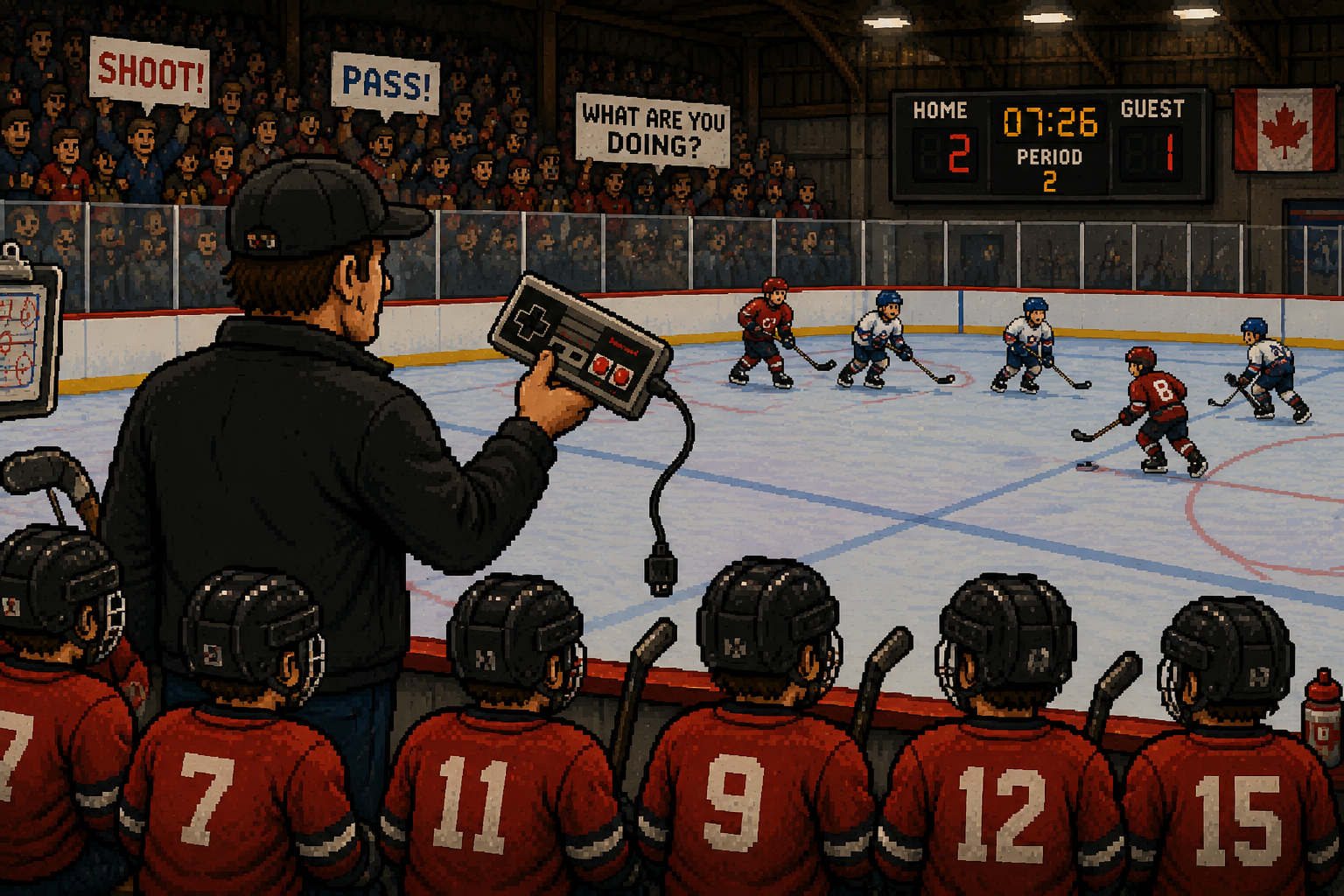
Somewhere along the way, I became convinced that a lot of people think coaches have a Nintendo controller hidden behind the bench.
You hear it every weekend.
"SHOOOOOOT!"
"PASS!"
"GET IT OUT!"
"SKATE!"
And my personal favorite:
"Why didn't coach tell him what to do?"
Trust me, if coaching hockey worked like Nintendo, life would be a lot easier.
Every breakout would work. Every pass would connect.
Nobody would miss an assignment. Nobody would forget the faceoff play we talked about thirty seconds ago.
Every coach would be Coach of the Year.
One of my favorite examples happens every time I attend a Steelheads game in Boise. The building is packed. Six thousand five hundred people are watching. The team gets a power play, wins the faceoff clean, and four seconds later the entire building has reached the same conclusion.
"SHOOOOOOOOT!"
Not forty seconds into the power play. Four.
The power play hasn't even had a chance to set up and everyone has already solved the problem.
It makes me laugh every single time because we've all done it.
Parents. Fans. Coaches. Players.
We watch the game and immediately start thinking about what should happen next.
The problem is the controller isn't plugged in.
The players don't respond when we hit A, B, Start, or Select.
They're human beings.
And human beings have this funny habit of making their own decisions.
The Game Is Easy From Above
One of the best teaching tools we have today is video.
In many ways it's the closest thing hockey has to Nintendo.
For the first time players get to see the game from above. We can pause it, rewind it, slow it down, and ask questions.
"What do you see?"
"What options did you have?"
"What could you have done differently?"
The funny thing is how easy the game looks on video.
It's easy to pause and say, "You should have passed."
It's easy to rewind and say, "You should have shot."
It's easy to freeze the frame and identify the perfect answer.
The challenge is that players don't get a pause button.
The game keeps moving. The information keeps changing. The decisions happen in real time.
The player with the puck isn't watching from the press box. They're seeing the game through a cage, at speed, under pressure, while trying to process information from every direction.
The game is easy from above.
The game is hard from ice level.
That's why hockey IQ isn't really intelligence.
It's processing speed.
It's recognizing situations and making decisions before the opportunity disappears.
Dad McCoach and the Goodie Bag
This brings me to one of my favorite youth sports characters.
Dad McCoach.
You know exactly who I'm talking about.
The game ends.
The players leave the ice.
The dressing room door closes.
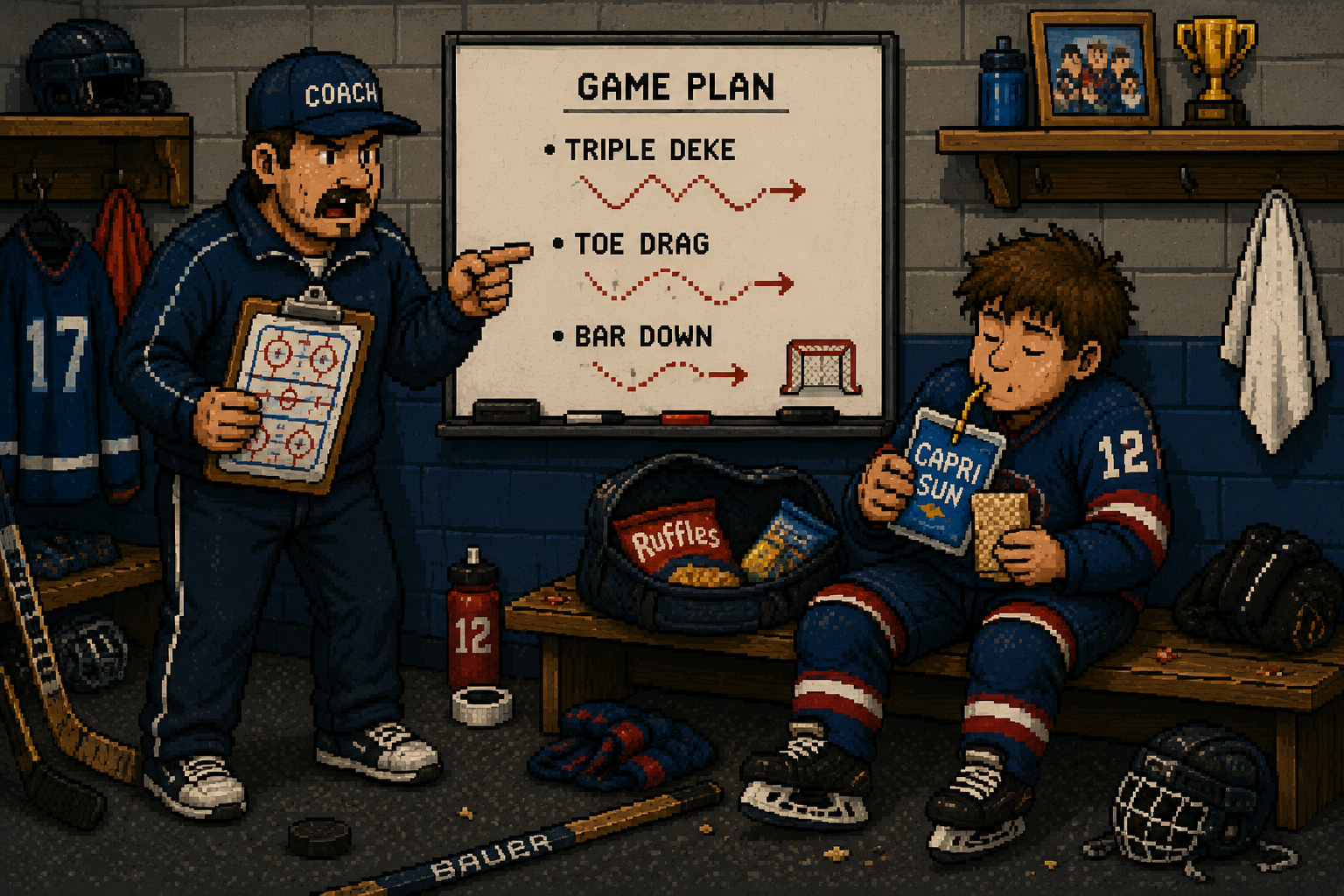
And before the skates are even untied, Dad McCoach has launched into a full postgame analysis worthy of Hockey Night in Canada.
"Why didn't you shoot?"
"Why didn't you pass?"
"Why didn't you go around the defenseman?"
Apparently the correct answer involved a Charlie Conway triple deke before going bar down over a goalie who has somehow been on his knees for the last four minutes.
Meanwhile the eight-year-old player is searching for the goodie bag from the family on snack duty.
One person is conducting a video review.
The other is hoping there is a Capri Sun and a Rice Krispie square waiting for him.
That's youth sports.
And sometimes we forget that.
Today's athletes are incredibly skilled. The skating is better. The training is better. The access to information is better. Players today sometimes look like video game characters.
But they aren't.
They're still kids. They're still learning. They're still making mistakes.
And that's where development lives.
One of the biggest mistakes we can make is confusing instruction with understanding.
If every answer is, "Just do this," eventually players stop thinking. They stop evaluating. They stop solving problems. They wait for instructions.
The goal isn't to create robots. The goal is to create thinkers.
Players who can read situations.
Adapt. Recover. Solve problems.
Because sooner or later every system breaks down.
And when it does, players have to think for themselves.
The Human Element Is The Story
I think this is why sports remain so fascinating.
The human element is the story.
The game refuses to stay inside the program.
The favorite can lose. The underdog can win. The late-round draft pick can become a Hall of Famer. A puck can take a bad bounce that changes an entire season.
In a video game, those moments feel like glitches.
In sports, they become history.
Think about every great sports movie you've ever watched.
The Mighty Ducks. Rudy. Miracle. Hoosiers. Remember the Titans.
Every story begins the same way.
No chance. No way. Impossible.
Then something happens.
A team starts believing. A player develops. A group comes together.
The game refuses to follow the script.
Suddenly the impossible becomes possible.
That's why we remember those stories.
Not because they were predictable.
Because they weren't.
Fantasy football reminds me of this every year.
Every fall I convince myself I've assembled the greatest roster in fantasy football history. I study matchups. Read projections. Listen to podcasts. Build a roster worth hundreds of millions of dollars.
Then Week 6 arrives.
Patrick Mahomes throws three interceptions.
Loses a fumble.
And somehow Rolling With Ma-Homies loses to Steve from accounting.
Reality has entered the chat.
Mahomes doesn't know he's on my fantasy team.
Just like your hockey player doesn't know what you yelled from Row 8.
Human beings do human things. That's why sports remain interesting.
You can't hit reset. You can't load a previous save. You don't get infinite lives.
And that's exactly why we watch.
The Skinny Guy, The Medium Guy, and The Big Guy
Organizations at every level are looking for players who fit what they believe. A youth coach, a prep school, a junior team, a college program, or an NHL organization are all trying to identify players that fit their identity.
In a funny way, they're doing the same thing I was doing playing Ice Hockey on Nintendo.
They're looking for their skinny guys. Their medium guys. Their big guys.
Not literally.
They're looking for players whose strengths fit what they're trying to build.
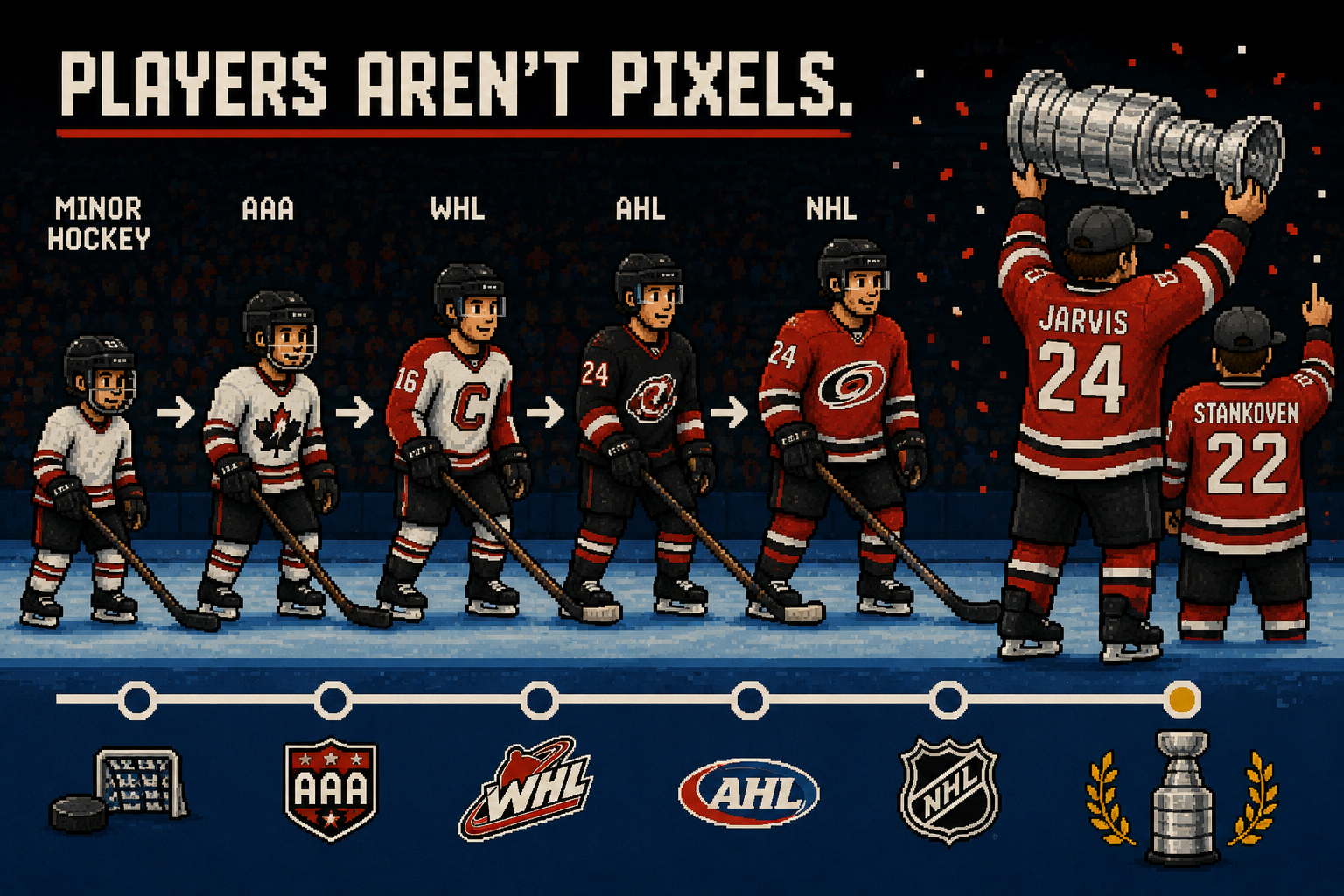
One of the reasons I found the Logan Stankoven trade so fascinating was because it highlights exactly how teams think. Most fans saw a blockbuster trade involving superstar talent.
Carolina saw fit.
They saw a player whose pace, competitiveness, habits, and style matched what they believed in.
The fact he's a Kamloops kid makes it even cooler for me.
Years ago he was another young player learning the game. Making mistakes. Solving problems. Developing.
Now he's helping a Stanley Cup champion because another organization believed what he brought fit their identity.
The same can be said for Seth Jarvis.
Neither player woke up one morning as an NHL star.
They moved through a development pathway.
Minor hockey. Development programs. Junior hockey. Professional hockey. NHL hockey.
Along the way they had coaches who taught them, challenged them, corrected them, and gave them opportunities to learn.
Most importantly, they were allowed to think.
Allowed to fail. Allowed to adapt. Allowed to grow.
That's the goal.
If we do our jobs right, players eventually leave us.
They move on to the next team. The next coach. The next level.
And someday another organization looks at them and says:
"We need that player."
No Reset Button
Maybe that's why sports have always fascinated us.
The game isn't programmed. The best player doesn't always win. The best team doesn't always win.
The perfect plan doesn't always work.
A pass misses. A puck takes a bad bounce. A goalie stands on his head. An underdog refuses to read the script.
That's the human element.
That's the part Nintendo never quite figured out.
As coaches, we spend countless hours trying to teach the game. We build systems. We create structure. We show video. We prepare players for situations they might encounter.
But eventually the puck drops. The controller disappears and the players have to play.
They have to think. They have to decide. They have to fail. They have to adapt. They have to solve problems.
The goal of coaching isn't to control players.
The goal is to teach players to play the game in such an organic fashion that it looks programmed.
Well-coached. Well-taught. Well-thought teams have success because when something goes off script, they adapt.
Sports would be much easier if coaches had controllers.
Sports would also be much less interesting.
And that's exactly why we love the game. 🏒
About the Author
Darrell Hay grew up playing street hockey by day and Nintendo by night. His gaming achievements include memorizing the Contra code, building championship teams on Ice Hockey, NFL Blitz battles with billets Joey and Chris in Kennewick, and contributing generously to the Golden Tee economy for more years than he'd care to admit.
He still believes Ice Hockey was the greatest sports game ever made and is thankful that real sports don't come with a reset button.
