The Janitor’s Key: How Elite Skating Unlocks the Modern Game
Every player wants great hands.
The toe drag.
The one-timer.
The social media clip.
But the deeper hockey evolves, the more one truth keeps separating players at every level:
Skating is the oxygen of hockey.
Without it, eventually you don’t survive.
That may sound dramatic until you watch where the game keeps going. Hockey is becoming younger, faster, and more dynamic every season. The players who continue advancing are usually the ones capable of moving efficiently within that chaos.
Because skating translates.
It creates offense.
It recovers defense.
It creates time.
It takes away time.
It allows players to attack.
That changes the competitive dynamic of the entire game.
The best skaters don’t just move fast.
They control pressure.
Offensively, skating creates breakouts, transitions, entries, offensive chances, and second opportunities. Defensively, it allows players to close space quickly, take away time, take away space and pressure attacking teams before offense fully develops.
And for all the entertainment hockey has become, the truth remains pretty simple:
The scoreboard still rewards the team that scores more goals.
Movement drives that.
The ABC’s Become the S
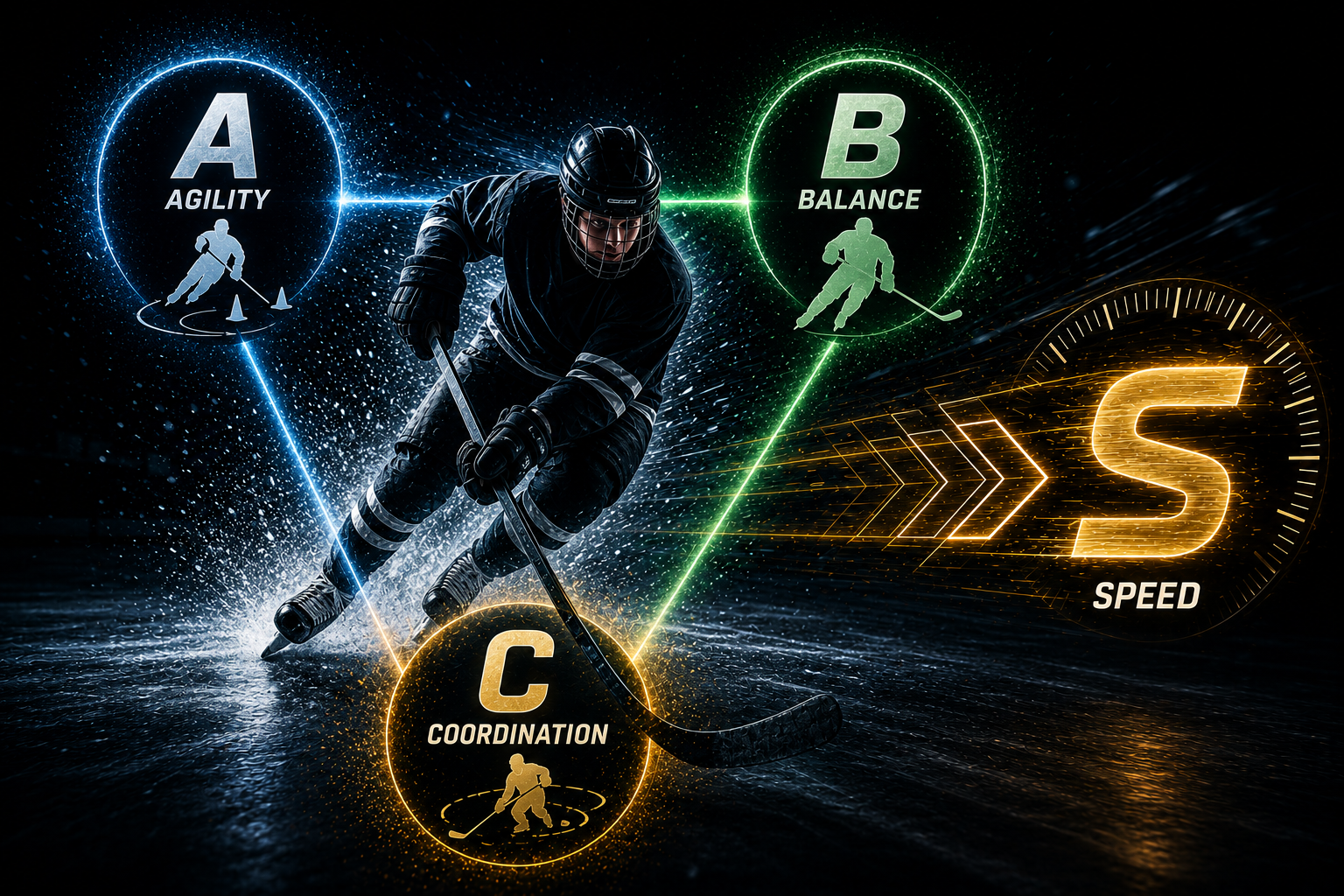
One of the smartest things USA Hockey emphasized early in player development was the importance of the ABC’s:
Agility.
Balance.
Coordination.
One of my colleagues once said something that always stuck with me:
“The ABC’s, agility, balance, and coordination. Done right, the S becomes speed.”
That’s modern hockey development in one sentence.
Because speed is not just straight-line sprinting.
It’s body control.
Edge control.
Mobility.
Posture.
Ankle flexibility.
Core stability.
Force transfer.
Recovery mechanics.
It’s the ability to move efficiently while processing chaos around you.
That’s why elite skating is developed through both technical repetition and athletic preparation off the ice.
Strong glutes.
Strong quads.
Strong core stability.
Mobile hips and ankles.
Efficient movement patterns.
I once had an off-ice coach tell me:
“We aren’t building bodybuilders. We’re building athletes strong from the nipples to the knees.”
I laughed immediately because all I could think about was the movie Meet the Parents, where Greg Focker explains to Jack Byrnes how he milked cats growing up and Jack’s legendary response:
“I have nipples, Greg. Could you milk me?”

Still makes me laugh.
But underneath the humor was a really smart concept.
Great skating is built through powerful, connected movement patterns, not just muscle size.
Speed Creates Time
Elite skating does something most people don’t fully appreciate.
It creates time.
The best skaters don’t just move faster. They slow the game down for themselves while speeding it up for everyone around them.
That’s the separator.
They win more races.
Escape pressure quicker.
Close gaps defensively faster.
Recover mistakes sooner.
Attack space faster.
Extend offensive possessions longer.
Time is everything in hockey.
And elite skating bends it.
That’s why every sport covets speed.
In football it stretches defenses.
In basketball it creates separation.
In soccer it drives transition.
In baseball it changes range and reaction time.
In hockey, speed changes the entire ecosystem of the ice.
That’s why skating translates so directly into advancement.
Why Apex Predators Adapt
In nature, apex predators stay at the top of the food chain because they evolve.
They adapt to changing environments.
They become more efficient.
More dynamic.
More dangerous.
Elite athletes are no different.
The players who stay on top the longest are rarely the ones satisfied with where they currently are. They understand the game keeps evolving, and if they stop evolving with it, eventually the game catches them.
That’s why so many of hockey’s apex players continue obsessing over skating and movement even after reaching the NHL.
Because skating translates.
It ages well.
It travels to every level.
It impacts every situation on the ice.
Players like Connor McDavid, Nathan MacKinnon, Cale Makar, Quinn Hughes, Jack Eichel, Mitch Marner, and Sidney Crosby don’t dominate because they skate fast in straight lines.
They dominate because their movement changes the ecosystem of the game around them.
That’s what apex players do.
They force everyone else to adapt to them.
The Problem With Skating
The hard truth?
Skating development usually isn’t glamorous.
There are no pucks on the ice.
No trick shots.
No social media clips after mastering inside edge posture.
When I was younger, going to people like David Roy in Kelowna, Audrey Bakewell in Kamloops, or the Acceleration Program skating treadmill at Lindsay Park in Calgary felt like eating vegetables as a kid.
Necessary.
Important.
But not exactly exciting.
At the time, I didn’t fully appreciate what those repetitive skating sessions were actually building underneath the surface.
But looking back, they became one of the biggest reasons I survived professionally for a decade and a half.
From North America to European Olympic-sized ice.
Because if you can’t skate on the big sheet, eventually you become prey.
The sick buffalo the wolves isolate from the herd.
The game finds you.
That’s what hockey does.
It exposes movement limitations quickly.
It’s also one of the biggest reasons the NHL consciously became younger over the last two decades.
The league didn’t suddenly stop valuing veterans.
It started valuing pace more aggressively.
Younger, faster, more dynamic players changed the way teams were built because movement increasingly drove the pace, pressure, and offensive creation that define winning hockey.That doesn’t mean older players became irrelevant.
It means older players who could still adapt and move retained value.
That’s why players like Corey Perry remain fascinating examples later in their careers.
Perry still understands how to impact games because he operates in areas where elite top-end speed matters less.
Along walls.
Around the crease.
Inside traffic.
In playoff-style chaos.
He still has enough pace to arrive and compete effectively in those areas, which is exactly why he continues finding value during playoff hockey.
But if the game turned entirely into a transitional track meet, he’d probably be on the bench hooked up to supplemental oxygen.
And that’s not disrespect.
That’s evolution.
The players who last longest are usually the ones capable of adapting their game to where hockey is going, not where it used to be.
And eventually every player faces the same question:
Can you move well enough to survive where hockey is going?
Speed Creates Trust
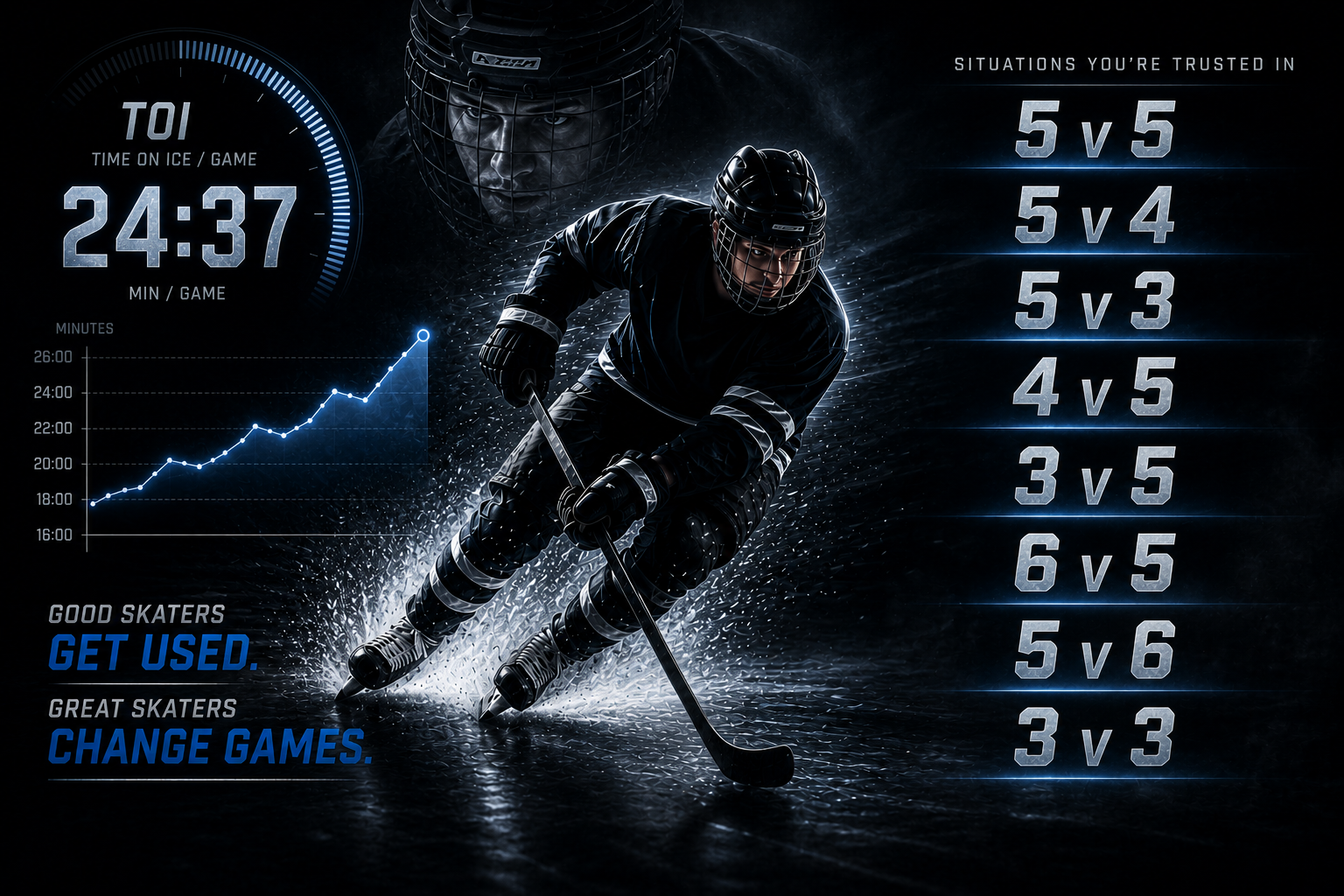
Elite skaters usually play more because speed drives games.
Coaches trust players who can move.
Players who recover quickly.
Pressure quickly.
Track quickly.
Transition quickly.
Attack quickly.
That trust creates opportunity.
More penalty kill time.
More power play responsibility.
More late-game situations.
More defensive-zone starts.
More overall ice.
Because skating creates adaptability.
And adaptable players survive longer as the game evolves.
That’s why elite skating quietly becomes one of the greatest predictors of:
advancement,
opportunity,
responsibility,
and longevity.
Elite skating becomes the janitor’s key that unlocks every door in hockey.
Final Thoughts
The game keeps evolving.
Faster.
Younger.
More demanding every season.
And eventually hockey stops asking whether you can play.
It asks whether you can move well enough to keep playing.
That’s why skating has become survival within hockey’s evolution.
Players who move well survive.
Players who skate well thrive.
Because in the modern game, skating becomes more than a skill.
It becomes access.
It becomes opportunity.
It becomes the janitor’s key that keeps unlocking doors.🏒
About the Author
Darrell Hay spent more than 16 years playing professional hockey across North America and overseas, where he learned quickly that skating translates at every level of the game. Inspired by elite athletes and hockey’s evolution toward speed and movement, he now works through DHHD to help players build the foundational habits, athleticism, and skating proficiency that unlock opportunity throughout their hockey journey.
